
Over the past two years, prompt engineering has become one of the hottest topics in artificial intelligence. Countless articles and tutorials promise to reveal the “perfect prompt” capable of unlocking extraordinary results from AI tools such as ChatGPT.
However, there is a fundamental misunderstanding.
Most businesses are focusing on the wrong variable.
The real differentiator is not the prompt.
It is the context.
This distinction may seem subtle, but it separates casual AI users from organizations that successfully integrate artificial intelligence into their business processes.
Prompt vs. Context
A prompt is simply an instruction.
For example:
“Translate this technical manual into English.”
or
“Write a professional sales email.”
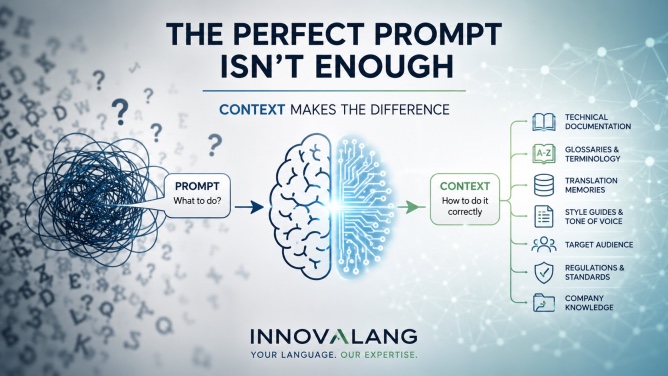
Context, however, includes everything that enables AI to understand what success actually looks like.
It includes:
- the industry;
- the target audience;
- the company’s tone of voice;
- approved terminology;
- translation memories;
- technical documentation;
- style guides;
- legal or regulatory requirements.
The prompt tells AI what to do.
Context tells AI how to do it correctly.
Why AI Makes Mistakes
Whenever AI produces an incorrect answer, people often conclude:
“ChatGPT made a mistake.”
In reality, AI frequently fills information gaps with statistically probable assumptions.
Large Language Models are probabilistic systems.
When critical information is missing, they simply generate the most likely answer.
Unfortunately, the most likely answer is not always the correct one for your company.
Consider the word “bearing.”
Depending on the context, it could refer to:
- a mechanical bearing;
- relevance;
- attitude;
- direction.
Only context allows AI to make the correct choice.
Your Company’s Greatest Asset Isn’t the Prompt
Most organizations already own an enormous amount of valuable knowledge.
The problem is that it is scattered across:
- technical manuals;
- procedures;
- product catalogs;
- specifications;
- FAQs;
- previous translations;
- regulatory documents;
- internal style guides.
If AI cannot access this knowledge, it cannot leverage it.
The result is lower quality, inconsistent outputs and higher revision costs.
Translation Memories and Glossaries Are Strategic Assets
Professional translation has understood this principle for decades.
Every completed translation creates reusable knowledge.
Leading organizations continuously build:
- terminology databases;
- translation memories;
- linguistic resources;
- editorial guidelines.
These assets deliver:
- greater consistency;
- faster turnaround;
- lower costs;
- higher quality.
Artificial intelligence does not replace these resources.
It makes them even more valuable.
From Prompt Engineering to Context Engineering
A growing number of AI experts are now talking about Context Engineering rather than Prompt Engineering.
This represents a significant shift.
Instead of creating increasingly sophisticated prompts, organizations should build systems that automatically provide AI with all relevant business knowledge.
This includes integrating:
- knowledge bases;
- technical documentation;
- CRM systems;
- ERP platforms;
- translation memories;
- terminology databases;
- document repositories.
The result is AI that works with your organization’s expertise rather than generic internet knowledge.
The Real Competitive Advantage
Two companies can use exactly the same AI model.
Exactly the same software.
Exactly the same prompt.
Yet obtain dramatically different results.
The difference lies in one factor:
One company has built a structured information ecosystem.
The other has not.
Artificial intelligence does not create knowledge.
It amplifies existing knowledge.
The richer the context, the better the output.
How InnovaLang Helps
For more than twenty years, InnovaLang has been helping organizations transform linguistic knowledge into a strategic business asset.
Every project contributes to building:
- translation memories;
- corporate glossaries;
- terminology standards;
- editorial guidelines.
Today these resources serve not only professional translators.
They have become essential fuel for modern AI systems.
Professional translation and artificial intelligence are no longer separate worlds.
They complement each other.
Success no longer depends on asking better questions.
It depends on giving AI better knowledge.
The organizations that will gain the greatest competitive advantage over the coming years will not be those that discover the perfect prompt.
They will be those that build the perfect context.
An article by Federico Perotto, InnovaLang Founder & CEO