
AI Is Creating a New Profession: The AI Intelligence Reviewer
Over the past two years, the debate around artificial intelligence in translation has often revolved around one question:
“Will AI replace translators?”
It is probably the wrong question.
The real transformation is not about translators disappearing. It is about the emergence of entirely new professional roles that did not even exist a few years ago.
Just as the Internet did not eliminate journalism but created SEO specialists, social media managers and content strategists, artificial intelligence is reshaping the language industry.
The future belongs neither to translators working against AI nor to AI working alone.
It belongs to professionals who know how to manage, supervise and validate artificial intelligence.
From Translator to AI Supervisor
Large language models are not autonomous experts.
They generate probabilistic outputs.
They may produce hundreds of excellent translations before making a critical mistake.
They may follow terminology perfectly in one section while ignoring it in another.
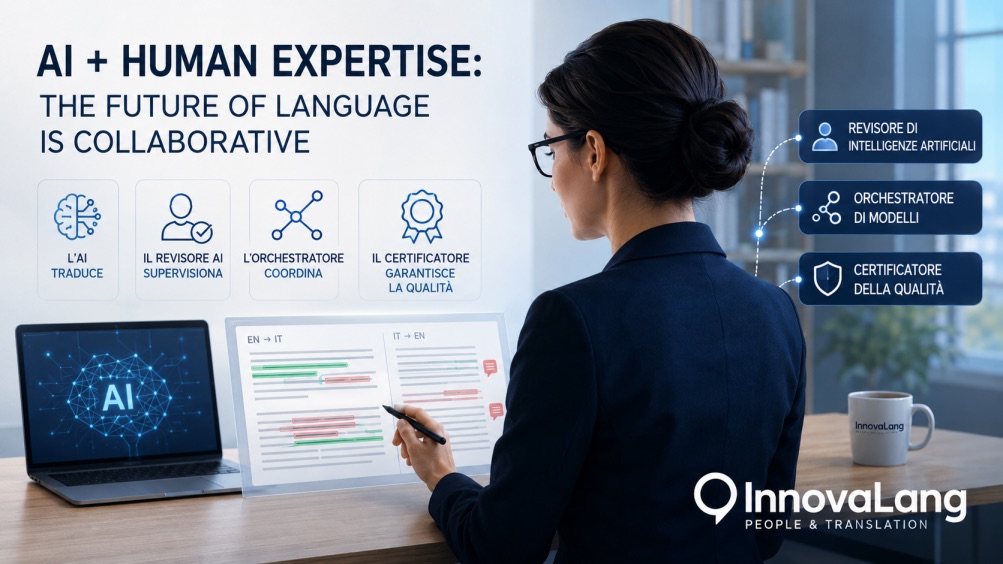
This is why a new role is emerging: the AI reviewer.
Instead of translating every sentence from scratch, this professional ensures:
- terminology consistency;
- technical accuracy;
- tone of voice compliance;
- adherence to client guidelines;
- glossary compliance;
- detection of AI hallucinations.
Their responsibility is to guarantee the final quality of the document.
Beyond One AI Model
There is no longer a single artificial intelligence.
There are dozens of language models, each with different strengths.
Some perform better in technical translation.
Others excel in creativity.
Others specialise in legal or medical terminology.
Leading companies increasingly compare several models simultaneously before selecting the best result.
This creates another emerging profession.
The AI Model Orchestrator
This professional decides:
- which model to use;
- when to use it;
- which prompts to provide;
- which translation memories to activate;
- which glossaries to include;
- how to compare outputs;
- when human intervention is required.
This role combines language expertise, technology and workflow management.
Quality Will Need Proof
Clients are beginning to ask questions such as:
- Which AI produced this translation?
- How much human revision was involved?
- Which quality controls were performed?
- Can the entire workflow be audited?
These questions are creating yet another professional role.
The AI Quality Certifier
Future language workflows will increasingly require specialists capable of certifying not only the final translation but the entire production process.
They will verify:
- AI models used;
- translation memories consulted;
- terminology databases applied;
- automated quality checks;
- human review stages;
- overall reliability of the final deliverable.
Transparency will become a competitive advantage.
The Skills Companies Will Seek
Tomorrow’s language professionals will need expertise in:
- AI supervision;
- advanced prompt engineering;
- translation memories;
- terminology management;
- multilingual quality assurance;
- AI benchmarking;
- hallucination detection;
- workflow optimisation.
Future linguists will increasingly resemble conductors coordinating multiple intelligent systems.
Human Value Is Increasing
Ironically, the better AI becomes, the more valuable human expertise becomes.
Technology automates repetitive tasks.
Humans remain responsible for:
- critical thinking;
- cultural understanding;
- business context;
- professional judgement;
- accountability.
AI generates possibilities.
Humans make decisions.
That difference is where true value lies.
Collaboration Is the Future
The most successful language service providers will not choose between humans and AI.
They will combine:
- specialised AI systems;
- professional translators;
- AI reviewers;
- AI model orchestrators;
- quality specialists;
- localisation experts.
Professional translation is not disappearing.
It is evolving into something more sophisticated, more transparent and ultimately more valuable.
At InnovaLang, we believe the future belongs to organisations capable of combining cutting-edge artificial intelligence with exceptional human expertise. Technology accelerates the process, but people remain responsible for quality, reliability and trust.