
(Estimated reading time: 5 minutes)
Translation has shaped human history. From the first inscriptions carved into stone to the sophisticated AI-powered translation tools we use today, the act of conveying meaning across languages has been a bridge between cultures, religions, and civilizations.
At InnovaLang, we believe that translation is more than just a linguistic service—it’s a cultural heritage that deserves to be celebrated and preserved. This is why we are working on the “Translation Museum” project, a future space—both virtual and potentially physical—dedicated to documenting the history of translation. The museum will collect:
✔ historical documents and objects,
✔ stories of key figures in translation,
✔ information on ancient and modern writing systems,
✔ anecdotes and case studies from across the centuries,
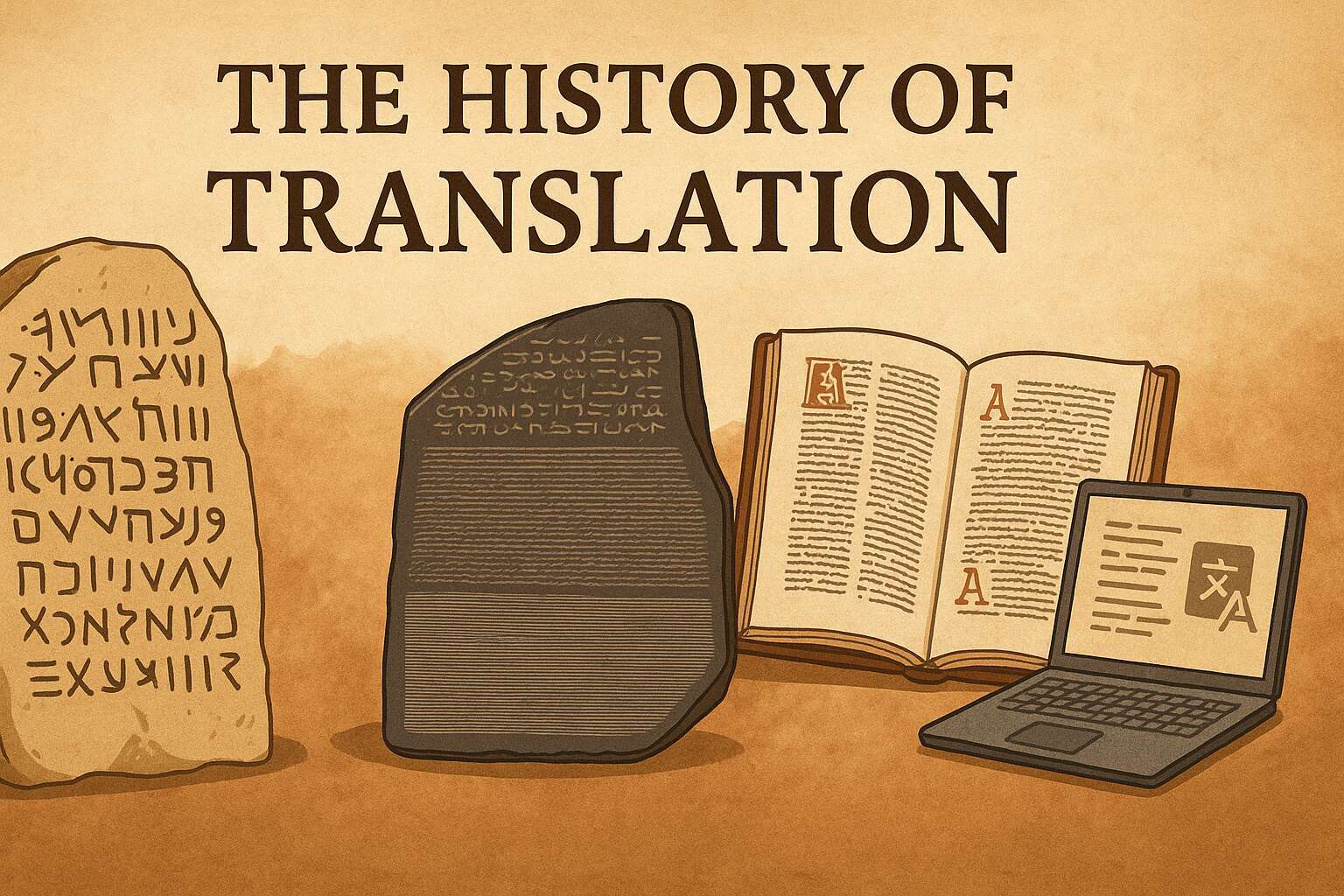
✔ and an exploration of technological advances, from the Rosetta Stone to AI in machine translation.
Let’s take a journey through the major milestones in the history of translation, tracing its evolution from ancient scribes to modern-day neural networks.
The Origins: Translation as the First Bridge Between Cultures
The earliest evidence
Translation began when humans started exchanging knowledge and goods between tribes. Oral interpretation was the first step, enabling trade and cultural exchange. Written translation emerged much later, as soon as writing systems developed.
One of the most famous early examples is the Stele of Nora (9th–8th century BCE), an inscription in Phoenician found in Sardinia. Though still debated among scholars, it provides insight into how different Mediterranean cultures interacted linguistically.
The Rosetta Stone: Decoding civilizations
The Rosetta Stone (196 BCE) remains the most iconic artifact in translation history. Inscribed in three scripts—Ancient Egyptian hieroglyphics, Demotic script, and Ancient Greek—it enabled Jean-François Champollion in 1822 to decode Egyptian hieroglyphs. This discovery did not just translate words; it unlocked the knowledge of an entire civilization.
Translation in Ancient Empires
- Mesopotamia and Sumer: Clay tablets show evidence of bilingual dictionaries between Sumerian and Akkadian.
- The Achaemenid Empire (Persia): Royal decrees were translated into several languages spoken across the empire, including Old Persian, Elamite, and Babylonian.
- The Roman Empire: Greek works were translated into Latin, introducing philosophy, science, and literature to Roman elites.
Translation in Religious and Cultural Exchange
Religion has been a key driver of translation. Missionaries, monks, and scholars played pivotal roles in spreading religious texts.
The Septuagint
Around the 3rd century BCE, Jewish scholars in Alexandria translated the Hebrew Bible into Greek. Known as the Septuagint, it was crucial for the spread of Judaism and later Christianity among Greek-speaking populations.
The Latin Vulgate
In the 4th century CE, Saint Jerome translated the Bible into Latin (the Vulgate), standardizing Christian scripture across Europe. His work set the foundation for translation theory, with his famous distinction between word-for-word and sense-for-sense translation.
The Islamic Golden Age
Between the 8th and 13th centuries, the House of Wisdom in Baghdad became a hub for translation. Scholars like Hunayn ibn Ishaq translated Greek philosophical and medical texts into Arabic, preserving and expanding upon ancient knowledge that later returned to Europe through Latin translations.
The Buddhist Sutras
In Asia, monks translated Buddhist scriptures from Sanskrit into Chinese, Korean, and Japanese. These translations were not literal; they adapted concepts to align with local philosophies and cultural contexts.
The Middle Ages: Scribes, Monasteries, and Multilingual Courts
During the Middle Ages, translation flourished in religious centers and multicultural cities.
Monastic scriptoria
Monks across Europe copied and translated classical texts, keeping alive works by Aristotle, Galen, and other ancient authors.
Toledo School of Translators
In 12th-century Spain, Christian, Jewish, and Muslim scholars collaborated to translate Arabic scientific and philosophical texts into Latin and Castilian. This movement introduced Europe to Arabic numerals, algebra, and Aristotle’s works.
Marco Polo and travel accounts
Travelers and merchants, such as Marco Polo, depended on interpreters to navigate the Silk Road, and their accounts were translated into multiple languages, spreading geographical and cultural knowledge.
The Printing Revolution and Early Modern Period
The Gutenberg Press
The invention of the printing press (15th century) accelerated translation. Books could now be mass-produced, increasing demand for translated works.
Luther’s Bible
Martin Luther’s German translation of the Bible (1522) was not only a religious milestone but also shaped the modern German language, demonstrating how translation can standardize national languages.
Scientific Exchange
As the Renaissance blossomed, scientists such as Copernicus and Galileo saw their works translated into Latin, facilitating a pan-European exchange of knowledge.
The 18th and 19th Centuries: Translation and National Identity
Romanticism and cultural pride
Translation became a tool for shaping national identity. Writers translated ancient epics and folklore to revive cultural pride. For example, Johann Gottfried Herder encouraged translations that respected the “spirit of the people” (Volksgeist).
Colonial Expansion and Interpretation
During colonial expansion, translation and interpretation played controversial roles, being used both to mediate and to dominate. Dictionaries and grammars of indigenous languages were created by missionaries and colonial administrators.
The 20th Century: Professionalization and Technology
The birth of professional translation
With the rise of international organizations like the League of Nations and later the United Nations, professional interpreters and translators became crucial. Simultaneous interpreting emerged during the Nuremberg Trials (1945–46), revolutionizing diplomacy.
Machine Translation Experiments
The first attempts at machine translation began in the 1950s, with the Georgetown-IBM experiment (1954) translating Russian into English.
Translation Studies as a discipline
The second half of the 20th century saw the birth of Translation Studies, with scholars like Eugene Nida (dynamic equivalence in Bible translation) and Itamar Even-Zohar (polysystem theory).
The 21st Century: AI and the Future of Translation
Today, translation is at the intersection of linguistics and technology. Neural machine translation, powered by AI, has drastically improved automatic translation quality. Tools like Patren and ChatGPT-based engines allow near-instant translations for millions of users.
However, human expertise remains essential:
✔ Technical and scientific translation—like the services we offer at InnovaLang—requires domain knowledge and regulatory precision that AI alone cannot guarantee.
✔ Legal compliance, cultural nuance, creativity, and ethical decisions still rely on human translators.
The “Translation Museum” Project: Preserving the Heritage of Translation
At InnovaLang, we are developing the “Translation Museum”, a project designed to celebrate the history and future of translation.
This museum—virtual and possibly physical—will collect:
✔ Artifacts such as replicas of the Rosetta Stone and ancient manuscripts.
✔ Stories of translators and interpreters who shaped history.
✔ Timelines of writing systems and alphabets, from cuneiform to Unicode.
✔ Technological evolution, from early typewriters to AI-based CAT tools.
✔ Interactive exhibits to explain semantic analysis, machine translation, and cultural mediation.
The goal? To show how translation has always been a key to human progress, connecting civilizations and shaping global knowledge.
Conclusion
Translation is not just a profession—it is a force that shaped history. From ancient scribes to AI-powered neural networks, translators have been mediators of knowledge, culture, and innovation.
As we move into an era of global sustainability and technological interconnection, understanding and preserving this heritage is more important than ever. The Translation Museum will honor this legacy, while services like those of InnovaLang ensure that translation continues to be accurate, compliant, and culturally aware—the same principles that have guided translators for millennia.