
In today’s hyperconnected economy, businesses can reach customers across the globe with just a click. But if your website doesn’t speak your customer’s language, your global expansion strategy is likely to stumble. Multiple studies confirm a powerful truth: language is not only a medium of communication, but also a driver of trust, loyalty, and sales.
What the Numbers Tell Us
Let’s start with some striking statistics from respected international sources:
- According to Think with Google, 72% of consumers spend most or all of their time on websites in their own language.
- A study highlighted by Helsingborg Innovation District revealed that 72% of customers prefer to shop from sites in their mother tongue, and 76% are more likely to buy products when product information is in their native language.
- Weglot (2025) reported that nearly 73% of customers prefer to purchase a product or service from a site that offers information in their own language.
- OneSky.ai (2025) emphasized that 72% of shoppers are more likely to buy from sites written in their native language.
These converging data points paint a crystal-clear picture: multilingual content is not a luxury, it’s a business imperative.
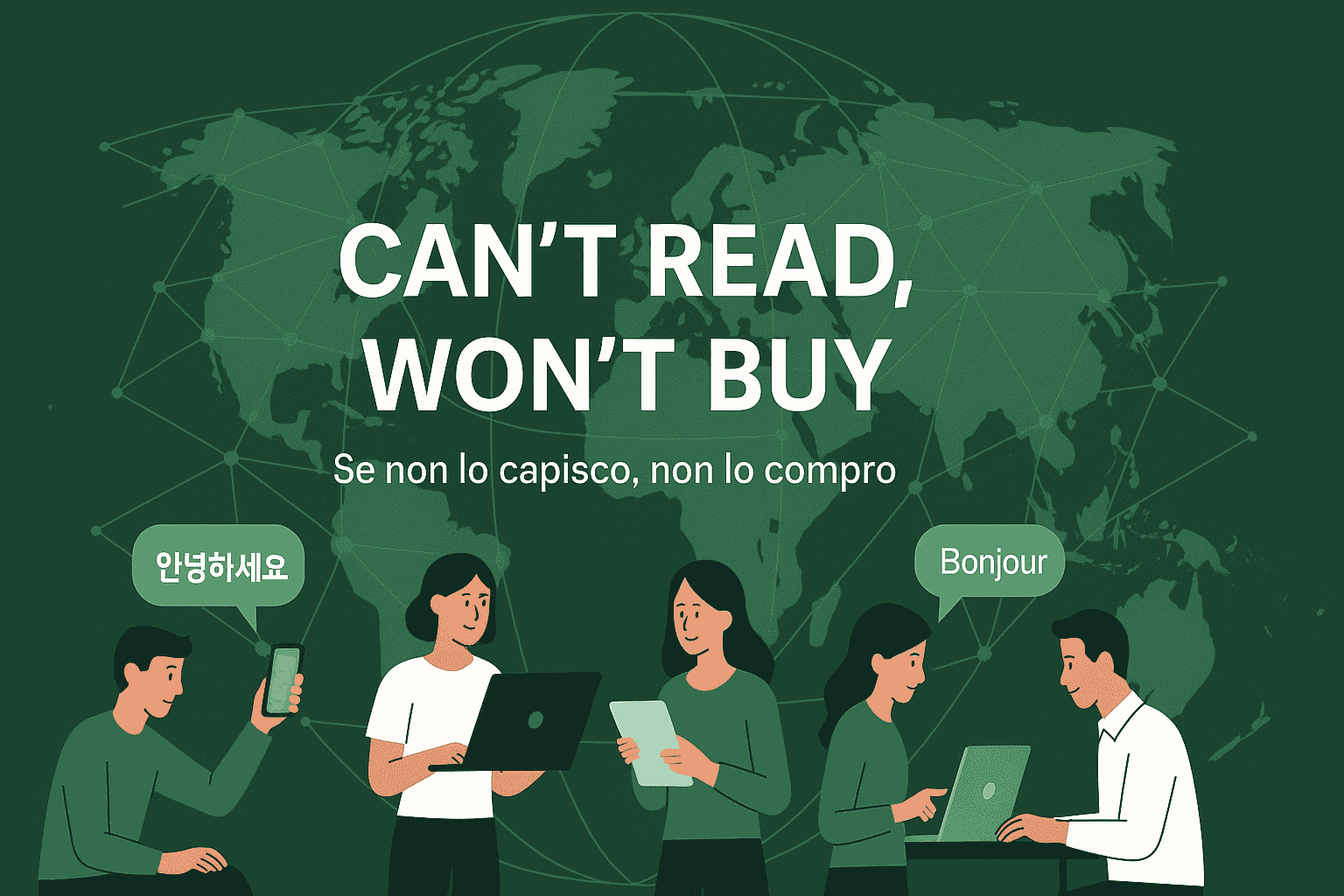
The Landmark Study: Can’t Read, Won’t Buy
The most authoritative research on this subject comes from CSA Research (formerly Common Sense Advisory). Their survey “Can’t Read, Won’t Buy – B2C” involved 8,709 consumers in 29 countries between late 2019 and early 2020. The results are revealing:
- 76% of consumers prefer to buy products described in their native language.
- 40% say they would never buy from websites in other languages.
- 73% want product reviews in their own language.
- 75% are more likely to repurchase from the same brand if customer care is offered in their language.
- Even among people with good English skills, 66% still prefer to buy when information is available in their mother tongue. This preference rises to 85% for those with limited English proficiency.
The conclusion is undeniable: language directly affects buying decisions. For brands, this means that cutting corners on translation can lead to losing customers—often before they even add a product to their shopping cart.
What This Means for Your Business
For companies seeking to expand internationally, investing in professional translation and localization is not just about cultural sensitivity—it is about maximizing conversion rates and ROI.
At InnovaLang, we help businesses go beyond simple translation. We ensure that your digital content—whether product descriptions, reviews, or customer support—is clear, persuasive, and culturally adapted to each target market. This approach creates trust, removes friction, and directly influences the buying journey.
Conclusion
The message is clear: If they can’t read it, they won’t buy it.
Global businesses that prioritize language accessibility are not only respecting their customers—they are also unlocking significant growth opportunities.