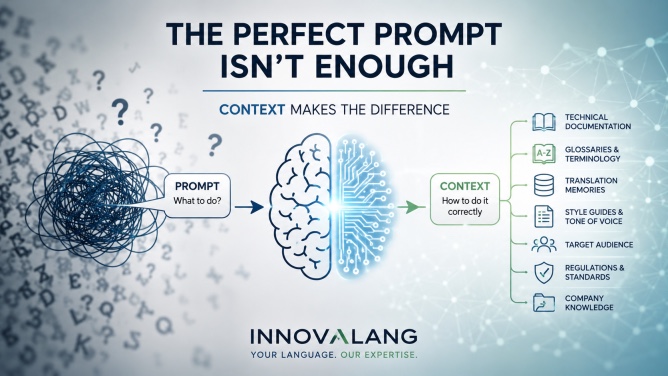


A document can be grammatically flawless and still fail to achieve its business objectives.
At first glance, this may sound contradictory. After all, isn’t the purpose of a translation simply to transfer meaning from one language to another?
Not anymore.
In today’s global marketplace, successful international communication requires much more than linguistic accuracy. It requires understanding cultures, customer expectations, marketing principles, and user experience.
This is why a technically perfect translation can still become a commercial failure.
Language Is Part of the User Experience
When people hear the term User Experience (UX), they usually think about websites, software interfaces or product design.
However, language is also part of the user experience.
Every sentence influences how customers perceive a company.
Words communicate:
- trust;
- expertise;
- innovation;
- friendliness;
- authority.
Even when readers cannot identify a specific problem, they immediately notice when a text feels unnatural.
That small feeling of discomfort may be enough to reduce trust—and ultimately reduce sales.
Translation Is Not the Same as Localization
Translation transfers meaning.
Localization adapts communication to a specific market.
That includes adapting:
- examples;
- measurements;
- currencies;
- dates;
- cultural references;
- calls to action;
- visual elements;
- communication priorities.
Customers in Germany, Japan, Brazil or the United States often expect completely different communication styles.
Ignoring those differences means ignoring part of your audience.
Tone of Voice Defines Your Brand
Every company has its own personality.
Some brands sound friendly.
Others sound authoritative.
Others focus on innovation or exclusivity.
If that personality disappears during translation, the brand itself changes.
Professional localization recreates the same perception—not simply the same words.
That is a much more demanding objective.
Marketing Is Never Universal
Marketing messages are deeply connected to culture.
The same campaign may generate outstanding results in one country and completely fail in another.
Different cultures prioritize different values, including:
- price;
- quality;
- sustainability;
- reliability;
- innovation;
- prestige;
- simplicity.
Understanding these priorities is essential for international success.
Modern translators increasingly combine linguistic expertise with intercultural consulting skills.
The Best Translation Is Invisible
The ideal translation never feels translated.
Readers should naturally assume the content was originally written in their own language.
When this happens, trust increases.
And trust remains one of the strongest drivers of purchasing decisions.
AI Helps—But It Doesn’t Replace Strategy
Artificial intelligence has dramatically improved translation quality.
Today’s AI systems produce impressive results in seconds.
However, language quality alone does not guarantee communication effectiveness.
Successful multilingual communication still depends on:
- audience understanding;
- industry expertise;
- cultural adaptation;
- terminology consistency;
- brand tone of voice.
Technology accelerates the process.
Human expertise ensures the message truly works.
The InnovaLang Approach
At InnovaLang, we see every translation project as an international communication project.
We combine professional linguists, AI-powered workflows, translation memories, terminology management and expert human review to deliver content that does more than sound correct.
Our objective is simple:
to make every translated document achieve the same impact as the original.
Because the real success of a translation is never measured by the absence of mistakes.
It is measured by the results it creates.